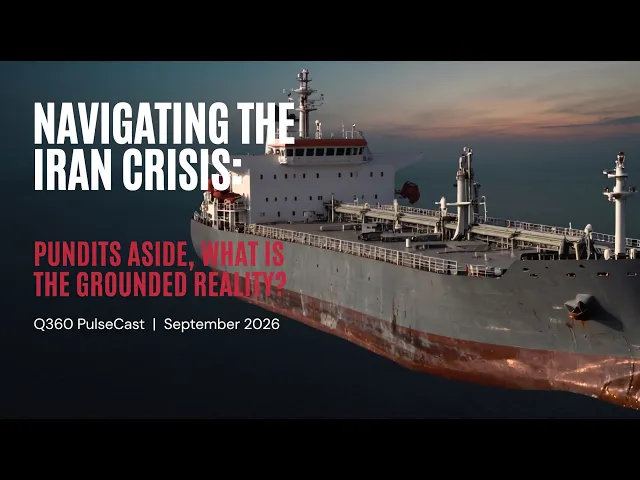
$130 Oil? What Consumers & Prediction Markets Know About the Iran Crisis
6 min read
The Grounded Reality in the Strait of Hormuz
If you’ve turned on the news recently, you know the situation in Iran—and particularly the Strait of Hormuz—is dominating global headlines. It is easy to feel overwhelmed by the noise. Our goal today is to strip away the hyperbole and give you a grounded, composite view of where things actually stand at the end of the third quarter of 2026.
To do this, we are looking at data from global prediction markets like Polymarket and Kalshi, backed by real capital. We are also pairing this market data with recent interviews of modeled synthetic US respondents to project consumer attitudes using our AI qualitative research platform, Q360 PulseCheck.
Shipping Traffic Collapse and Energy Market Shockwaves
The physical reality on the water is seeing severe disruption. Daily commercial vessel transits through the Strait of Hormuz have collapsed from 85 transits per day to just 6—a 93% decline. Alongside this, war-risk insurance premiums for crude carriers in the region have surged by up to 4000%.
On the commodities prediction exchange Kalshi, expectations for extreme energy prices have shifted rapidly. The probability that crude oil will breach $115 a barrel before year-end recently rose to 32%, and the chance of it crossing $130 now stands at 22%.
US Consumer Impact and Behavioral Shifts
When we look at our projected consumer drivers, it is clear this market reality is hitting household confidence hard. Modeled US respondents describe rising gas prices as a daily stressor, especially with inflation stubbornly holding at 3.4%.
To cope, Americans are "controlling their controllables"—turning down thermostats, managing utilities, and cutting discretionary spending. Broader life decisions, such as buying a home, are being deferred in favor of holding cash and maintaining day-to-day financial flexibility.
The Diplomatic Paradox
While physical shipping markets flash red, political prediction markets paint a picture of temporary optimism. On Polymarket, traders currently assign an 88% probability to a US-Iran ceasefire by September 30th.
However, traders see this as a temporary band-aid, likely driven by domestic political pressures ahead of the US November elections. Prediction markets project only an 11% chance of a long-term nuclear agreement before 2027, and just a 20% chance that Strait of Hormuz traffic returns to normal by December 31st.
Three Potential Outcome Scenarios for the End of 2026
Based on the current synthesis of market probabilities, we are looking at three primary scenarios for the balance of the year:
Prolonged Asymmetric Attrition (45% Probability): Diplomatic talks stall, the Strait remains closed to standard traffic, and oil establishes a volatile floor between $95 and $115 per barrel.
Tactical De-escalation (35% Probability): An indefinite pause takes hold following the mid-term elections. Oil prices retreat to the mid-$80s, but clearing maritime logistics and rebuilding insurance frameworks takes multiple months to normalize.
Strategic Escalation Tail Risk (20% Probability): A severe tactical incident triggers broader infrastructure targeting, pushing oil above $120 a barrel and tipping the US economy closer to a recessionary mindset heading into 2027.
Stay Grounded
While geopolitical friction creates unavoidable volatility, global systems and households are remarkably resilient. Supply chains eventually reroute, and consumers pragmatically adapt to new normals. Understanding these dynamics through probability-based data is a better tool for maintaining perspective than relying solely on news headlines.
Want to test these same synthetic consumer models on your own product concepts or brand messaging? Run a Q360 PulseCheck Study Today.
© 2026 Q360 Insights, LLC